
Validation Studies
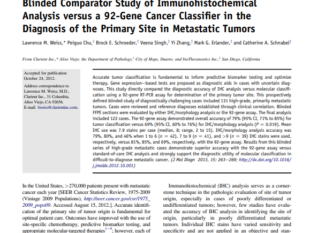
Accurate tumor classification is fundamental to inform predictive biomarker testing and optimize... Show more
Accurate tumor classification is fundamental to inform predictive biomarker testing and optimize therapy. Gene expression–based tests are proposed as diagnostic aids in cases with uncertain diagnoses. This study directly compared the diagnostic accuracy of IHC analysis versus molecular classification using a 92-gene RT-PCR assay for determination of the primary tumor site.1
Available free online from The Journal of Molecular Diagnostics.
1. Weiss LM et al. J Mol Diagn. 2013;15(2):263-269.

Molecular tumor profiling is a promising diagnostic technique to determine the tissue of origin in... Show more
Molecular tumor profiling is a promising diagnostic technique to determine the tissue of origin in patients with carcinoma of unknown primary site (CUP). However, the clinical value of these molecular predictions is unknown. We used tumor profiling results to direct site-specific therapy for patients with CUP.1
Available with partial online access from Journal of Clinical Oncology.
1. Hainsworth JD et al. J Clin Oncol. 2013;31:217-223.
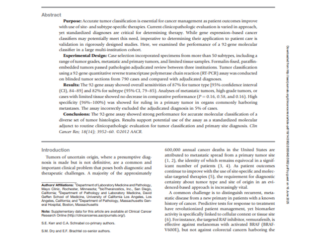
Accurate tumor classification is essential for cancer management as patient outcomes improve with... Show more
Accurate tumor classification is essential for cancer management as patient outcomes improve with use of site- and subtype-specific therapies. Current clinicopathologic evaluation is varied in approach, yet standardized diagnoses are critical for determining therapy. While gene expression–based cancer classifiers may potentially meet this need, imperative to determining their application to patient care is validation in rigorously designed studies. The study examined the performance of a 92-gene molecular classifier in a large multi-institution cohort.1
Available free from Clinical Cancer Research, an AACR publication.
1. Sarah E et al. Clin Cancer Res. 2012;18(14):3952–3960.